Faster promotions for new manager: Impact over theater

Leiderschapscoach Amsterdam | David Buirs

This article contrasts political games with genuine impact as a strategy for promotion. It highlights the Power Paradox and the Peter Principle for new managers. Four concrete tips provide a path for sustainable growth through personal development and feedback.

Everyone wants to move up. You just became a manager and you are already looking at the next step. VP. Director. Climbing the ladder. That is normal. Ambition is fuel. However, there are two ways to get faster promotions for new manager. One works in the short term but leaves you empty. The other might take a bit longer, but it makes you a better leader.

The Fast (But Empty) Route

You know them. The managers who know exactly when the director walks by. Who are always in the right meetings. Who slime their way up by saying exactly what the boss wants to hear. Corporate politics. Visibility over impact. Talking about results instead of actually achieving them. Does it work? Yes, sometimes. You can become a VP that way. Maybe even quickly. And then? Then you have a title. But no respect. No team that truly has your back. No feeling that you are building something meaningful. You wake up as a VP and feel empty. Because deep down you know: you didn’t make the impact you were capable of. You just played the game better.

The Power Paradox

Psychologist Dacher Keltner discovered something interesting. People often rise to power through traits like empathy, collaboration, and helping others. But once they have that power, they lose those exact traits. They become more selfish. Less empathetic. More focused on themselves. And then they start losing that power. That is the paradox. The qualities that get you to the top are not the same ones you use once you are there. Unless you pay attention to it, for example through leadership coaching.

The Better Route: Focus on Impact

Here is another way to get ahead. Become obsessively good in your current role. Don’t play politics. Ask yourself this question instead: what positive impact can I make on the people around me? On your team. On other departments. On your boss. On clients. If you get promoted? Great. Bigger role, bigger impact. If it takes longer? You are already doing work that matters. You are building something. You are developing people. You are making things better. This approach might feel slower. But in the end, you go further. With more respect, more impact, and a team that actually supports you.

4 Tips to Grow Faster (The Right Way)

  1. Ask Your Manager What Success Looks Like
    Most new managers guess what their boss finds important. And they usually guess wrong. Just ask. “What would success look like for me in six months? What should I focus on?” And also: “How do you want me to communicate with you? Weekly updates? Only when there are problems? How often do you want to speak?” This sounds basic. Yet most managers don’t do it. They assume they know. And waste energy on things their boss doesn’t even see.
  2. Ask for Constant Feedback
    Many managers wait for their annual review. Too late. Ask someone every week: “How am I doing? Where can I improve?” Ask your boss. Your team. Colleagues. Even people outside your department. This also protects you against the Peter Principle. People get promoted to their level of incompetence. They were good in their previous role, so they get a new one. One they are less good at. And they get stuck there. Feedback helps you keep growing instead of stagnating.
  3. Spend 1-2 Hours Per Week on Personal Development
    This is where most managers fail. They are too busy. Too many meetings. Putting out too many fires. So they spend no time on learning. On reflecting. On consciously getting better. Here is the secret. Few managers do this. If you do it, you have a huge advantage over your competition. 1-2 hours a week. That is it. Read a book on leadership. Take a solid management training. Reflect on what went well and what didn’t. Write down what you learn. Managers who do this grow faster. Not because they play politics, but because they objectively become better.
  4. Make Other People Successful
    Do you want to move up? Help your team grow. Help other departments succeed. Make your boss successful. When you make people around you better, it comes back to you. Not always immediately. But it returns. And when you grow into a larger role, people follow you. Because they know you care about their success, not just your own promotion.

Where Do You Focus?

You can take the fast route. Play politics. Be visible. Slime up. Or you can focus on impact. On meaningful work. On helping people grow. Both can get you a promotion. Only one lets you wake up with the feeling that you are building something that matters. Getting faster promotions for new manager starts with the question: do you want a title, or do you want to be a leader people want to follow?

Interested or curious? Let’s chat! Plan your free introduction here. Zero obligation.

Stop promoting your best experts into failing leaders

Leadership coaching Amsterdam | David Buirs

Summary: This article analyzes Gallup’s data on management talent and the impact of AI on leadership requirements. It argues that while technical management skills are becoming automated, human-centric coaching and communication skills are becoming the primary value drivers. The content advocates for leadership training for new managers as a strategic necessity for organizational relevance.

Gallup studied 2.5 million teams. The conclusion was shocking. Only 10% of managers naturally possess the talent to lead well. The other 90% require deliberate development to succeed.

Most companies ignore this. They take their best individual contributor, hand them a new title, and hope for the best. This is what is causing the huge global drop in workplace engagemement: untrained and disengaged managers. Train them, Gallup says, and we can unlock close to 10 trillion USD (!) in productivity.

The invisible cost of the management gap

When a promotion happens without leadership training for new managers, the team pays the price. You see it in the data. Performance slips. People stop speaking up in meetings. Eventually, your best talent leaves.

The pain is felt most by HR. You are left putting out fires caused by leaders who do not know how to lead. You deal with high absenteeism and the cost of high employee turnover.

The transition from peer to manager is not a step up a ladder. It is a complete change in craft. The technical skills that made them a top performer are now secondary.

Why AI makes human leadership non-negotiable

The rise of AI is rapidly devaluing technical expertise as a management cornerstone. When machines can handle data analysis, scheduling, and technical optimization, the demand for managers with purely hard skills will decrease. Conversely, the demand for strong communication and coaching skills will increase.

In an automated world, the only remaining competitive advantage for a leader is the ability to connect, inspire, and develop others. This shift makes leadership training even more important for companies and leaders that want to stay relevant. If you cannot coach, you will become obsolete.

Personal leadership as the foundation

Management is not about controlling others. It starts with personal leadership. A manager who cannot regulate their own stress or own their calendar will never build a high-performance team.

We often see “corporate theater” where managers pretend to have control while drowning in role ambiguity. Without a grounded philosophical approach to their new responsibility, they default to micromanagement or total avoidance.

How to reduce absenteeism and turnover

To fix the engagement crisis, leadership must be treated as a clinical skill.

  1. Identify leadership potential before the promotion. Not every expert wants to manage people.
  2. Implement evidence-based leadership programs. Focus on measurable ROI.
  3. Provide leadership coaching for those in the first four years of their role. This is the critical window where habits are formed.

Conclusion

Leadership is not a reward for past performance. It is a service to the future of the organization. If your managers are struggling to delegate or fear giving feedback, they are not failing you. The system failed them by leaving them untrained.

Schedule a free introduction call here to discuss the possibilities for your company..

The Identity Crisis: What are we actually here to do?

David Buirs | Leadership Coach & Management Trainer

Summary: This article defines the fundamental responsibilities of a first-time manager by addressing the “Player-Coach Trap.” It argues that primary duties shift from technical output to human-centric leadership and providing team perspective. The core responsibility highlighted is the development of an inner compass through reflection to lead others effectively.

Welcome to the first edition of The Next Level Manager.

I am David. I want to help you find some breathing room in your own to-do list.

In my coaching work, I see the same pattern over and over. I call it the “Player-Coach Trap.” It happens when you think your value still comes from the technical tasks you used to do: the code, the deals, or the designs.

It does not.

The Shift: Leading from the Inside Out.

Moving to the next level means your priority has to change. You are not responsible for the work anymore; you are responsible for the people.

This requires a different kind of growth. It is not about learning a new software, but about developing the maturity to handle the human side of business. This is where “perspective” comes in. To bring it, move from giving the answer to asking deepening questions:

  • “What haven’t we thought of here?”
  • “What is a different way this could work?”
  • “What is the essence of what we’re trying to accomplish. Are we still moving towards that?”

The source of these questions must be your own deep sense of what you and your team’s mission is, and why. If you have that inner compass, you will naturally sense when the team deviates from the course. You’ll get it through reflection. Quiet, focused, thinking-time. Even 5 minutes a day is enough.

The Main Question to Ask

You can ask yourself: achieving what 3 objectives will make you score your year a 100/100 at the end? That’s where your compass is pointing.

You cannot give your team clarity if you do not have it yourself.

From this position of clarity, you can help your team gain perspective. Through questioning. By asking these questions, you don’t “fix” the problem for them; you help them see the path back to the track themselves. Giving someone the answer is like scrolling their social media feed for them: it’s forgotten the next minute. But helping them find new answers themselves, is what actually helps them grow, comparable to making their own social media post. That’s what they’ll remember.

The First Step

Leave the hero role behind. Your job is no longer to be the most productive person in the room, but to be the one who brings the most perspective to it. When you make that shift, you will feel it immediately. You’ll have achieved a different, more relaxed state. And from that, you can start making a much bigger impact.

The next level is not a promotion. It is a decision to lead from the inside out. It starts with you.

Why your team meetings feel like a slow death

David Buirs | Leadership Expert

This article provides a strategic framework for new managers on how to lead team meetings better through boundary setting and a team charter. It identifies the psychological resistance to confronting senior staff and provides a downloadable manifesto for team efficiency, which can be used by managers and non-managers (informal leadership) alike. The focus is on moving from reactive management to proactive leadership impact.

Your inbox is a crime scene. Deadlines stack up while you sit in another hour of corporate theater. A senior lead invites you to a meeting with no agenda. No context. You watch your afternoon vanish in real-time.

Most new leaders treat these invites like a summons to court. You show up. You endure ten minutes of weather talk. You watch a colleague turn a “short update” into a personal manifesto. You leave the room feeling drained. If you want to know how to lead team meetings better, stop being a hostage to them.

The cost of passive leadership

Real leadership requires backbone. You must realize that your time is your only true capital. If you do not manage yourself, you cannot manage a team. You are simply reacting to the loudest person in the room.

You have two choices when the “agenda-less” invite arrives.

You can pretend your Wi-Fi died and vanish. It is a temporary escape, but it solves nothing. Or, you can be direct. Ask a simple question before you click “Accept”: “What is the specific goal of this meeting so I can prepare properly?”

From corporate theater to a team manifesto

During the session, be the one who interrupts the noise. When the conversation drifts, name the pain. “We are off-topic. Let’s get back to the objective.”

If you want your team to change their behavior, use this meeting efficiency manifesto. It is a team charter designed to kill the fluff and focus on impact. You can even introduce it without being the formal leader of the group. By doing show, you demonstrate informal leadership.

The managers I support in leadership coaching often fear this confrontation. They think the room will bite back. It won’t. Most people will silently thank you for rescuing them from another hour of wasted budget.

Stop “putting out fires” by attending every fire drill. Start owning the room by owning your boundaries.

Schedule a free introduction call to discuss the possibilities for your situation and see if there is mutual chemistry here.

Performance reviews don’t have to feel like a root canal treatment

David Buirs - Leadership Coach & Management Trainer

This guide provides performance review tips for new managers to handle difficult evaluations without stress. It focuses on the transition from peer to leader and the importance of personal leadership in giving feedback. The content explains how to replace “putting out fires” with clear, goal-oriented communication.

Clammy hands. Lead in your shoes. You are staring at a calendar invite for a conversation you don’t want to have. You know the team member has underperformed, but you have avoided the tension for months. This is the reality of the manager who prioritizes being liked over being clear.

The failure of the annual surprise

Performance reviews are often a theater of the absurd. Many managers postpone feedback because they fear confrontation. They incorrectly assume feedback is an attack. Without personal leadership, you lack the internal compass to deliver difficult truths. If a rating causes a shock, you haven’t been leading; you’ve been spectating. Continuous leadership coaching helps you move from avoiding heat to managing it.

Tips for giving feedback with integrity

To fix the review process, you must change your daily habits. Follow these principles to regain control:

  • Set measurable goals. Without a yardstick, your assessment is just an opinion.
  • Kill the surprises. The review should be a high-level summary of a year-long dialogue.
  • Abandon the need to be liked. Your job is clarity and integrity.
  • Neutralize the emotional charge. When a team member gets angry, stop the content. Address the emotion calmly and resume only when the room has settled.

Ownership of the message

If you are delivering bad news due to budget cuts, you must understand the reasoning yourself. Don’t be a messenger who shrugs their shoulders. Ask your own management the hard questions so you can stand behind your words. Effective management training ensures that your team knows what success looks like and exactly how they are rewarded.

Schedule a free introduction call here to discuss the possibilities for your context.

Time management for new managers: Escape the urgency trap


This article provides a strategic framework for time management for new managers, focusing on the shift from reactive firefighting to proactive leadership. It explains how to use the Important vs Urgent Matrix to delegate effectively and reduce operational stress. The guide emphasizes that personal leadership is the foundation of long-term managerial success


Time management for new managers: Escape the urgency trap

The promotion felt like a reward, but the reality feels like a trap. You spent years becoming an expert in your field, only to find that your expertise is now the very thing keeping you stuck in the office at 7:00 PM. You are drowning in a sea of “quick questions” and urgent emails while your own strategic work gathers dust. This is the core challenge of time management for new managers: distinguishing between being busy and being effective.

From expert to firefighter

Most managers are addicted to the “urgent”. It provides an immediate dopamine hit to solve a problem or answer a crisis. We call this “putting out fires management”. You feel necessary, but you are actually stagnant. By constantly reacting, you neglect the Personal Leadership required to build a self-sustaining team. You are not leading; you are just the most stressed person in the room. The effect driving this is called the Mere Urgency effect, a bias us humans have to focus on things that are urgent rather than important.


Using the Matrix to reclaim your day

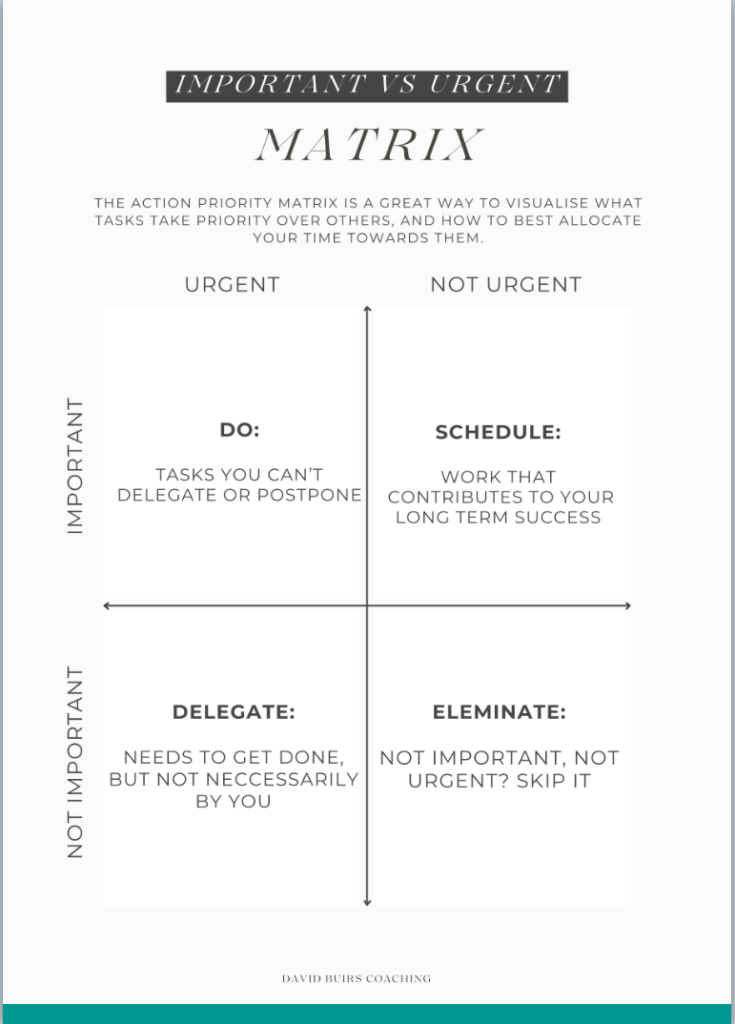
To master time management for new managers, you must look at your tasks through the lens of the Important vs Urgent Matrix. Most managers live in the bottom-left quadrant—tasks that need to get done, but not necessarily by you. This is the “Delegate” zone.

By categorizing your work, you identify what truly contributes to your long-term success. It forces you to schedule the work that matters and eliminate the noise that masquerades as an emergency. It is a tool for clarity in a world of role ambiguity.
 

Efficiency as a byproduct of Personal Leadership

Real leadership is the art of becoming obsolete in the daily operations so you can focus on the growth of the team. If you are still “doing” instead of “leading,” you are stealing development opportunities from your team. Effective time management is not about doing more; it is about doing less, better. Here are 3 tips to help you:

  • Kill the notifications: It takes 23 minutes to regain deep focus after a distraction.

  • The 60-minute block: Schedule one hour of “uninterruptible” time daily for strategic thinking.

  • The “No” Audit: If a task doesn’t require your specific leadership level, it belongs on someone else’s desk.

Investing just 2 hours a month in leadership coaching provides the external perspective needed to stop being a firefighter and start being a leader.

Schedule a free introduction call here to discuss the possibilities for your specific situation.


AI and Leadership – How do Managers Prepare for the Future?

AI and Leadership event

AI sometimes reminds me of the game peek-a-boo. Every time you open your eyes, it has moved closer, and much faster than you think.

As a leadership coach and trainer, I’m very interested in AI and its implications for leadership. That’s why I attended the D2 collective’s “Leading the Next Generation of Work” event at the Prosus office this week, listening to senior leaders from companies like Microsoft and Prosus. Again, I’m amazed by how fast things are moving.

Especially around the role of agents: pieces of software you can program using natural language through tools like ChatGPT or Gemini. They execute tasks and work autonomously.

For example, you can say: “When a customer emails about a refund, pull up the customer data, decide whether to approve it based on these criteria. If approved, initiate the refund and reply with a confirmation”.

Without human intervention. Some companies have up to 30,000 different agents. Whatever one learns, others pick up immediately. The speed of learning is tremendous.

In the coming years, most of us will be managing agents. This sounds either amazing or dystopian, depending on your perspective. But the predictions go further: many of us will be managed by an AI agent. We also expect the first billion-dollar company run by a single human, assisted by agents, within the next few years.

This will significantly impact the job market. Technical knowledge on an individual level will become less valuable and companies will likely need fewer employees. We are already seeing this trend.

As agents take on more and more tasks, a human will need to be accountable for the outcome. Job descriptions will shift from a focus on tasks to a focus on accountability.

The traditional role of middle management has been to relay information from the floor to leadership. AI can do this more efficiently, making traditional middle management either obsolete or frees them to focus on coaching and support.

In general, I expect companies to need fewer managers. Because typical managerial tasks can be automated, time is freed up for leadership work like coaching.

My advice to all managers: start developing those human skills now.

We are not powerless. Certain skills will become increasingly relevant to staying valuable in the job market:

• Judgment and critical thinking: A human remains responsible for the outcome. AI can make mistakes.

• Curiosity: Having powerful AI without knowing asking the right questions is like owning a Ferrari you cannot drive. “Garbage in, garbage out” still applies.

• Emotional intelligence: As technical work is automated, what remains are interpersonal tasks like coaching, communication, and brainstorming.

How to start? If you’re not using AI yet, start practicing with LLMs like ChatGPT or Gemini. If you already do, practice creating better prompts or try building your first agent for a simple task.

In my leadership coaching and management training, I help my clients to stay relevant over the coming years.

Interested? Let’s talk. Schedule your free introduction here.

AI and the Future of Leadership

EY - Future of Work Event Amsterdam

This week I joined the “𝗪𝗵𝗮𝘁 𝗖𝗮𝗻’𝘁 𝗕𝗲 𝗥𝗲𝗽𝗹𝗮𝗰𝗲𝗱 𝗯𝘆 𝗔𝗜” event at EY’s Amsterdam office, hosted by Maarten Lintsen, with sharp insights from Anna van den Breemer- Kleene, Isabel Moll – Kranenburg, and Rina Joosten-Rabou.

I went because I’m fascinated, sometimes a bit scared even, by how fast this field is moving and what it means for leadership, work, and meaning. Here’s what I picked up.

𝟭. 𝗧𝗵𝗲 𝗺𝗲𝘁𝗮-𝘃𝗶𝗲𝘄

A theme that surfaced in the panel and in a side conversation with Marielle Willemse: leaders need the capacity to zoom out. To look at their strategic goals, and find creative ways of making AI work for them. To avoid AI tunnel vision.
Take recruitment. If efficiency is the only aim, we automate CV screening. Yet CVs predict about 3 percent of job success. Faster, not smarter. The better question is how AI helps us hire people with those skills that can transform and innovate an organisation. Use AI to assess skills and potential, not to count CV buzzwords.

𝟮. 𝗟𝗲𝗮𝗱𝗲𝗿𝘀𝗵𝗶𝗽

Only those leaders that adapt fast enough to AI will remain. Relevance requires AI literacy. Which isn’t coding, but understanding how you can make it work for you. Leaders must make it safe to experiment. If teams are scared to try, adoption among employees slows.

𝟯. 𝗞𝗻𝗼𝘄𝗹𝗲𝗱𝗴𝗲 𝗮𝗻𝗱 𝗽𝗿𝗼𝗱𝘂𝗰𝘁𝗶𝘃𝗶𝘁𝘆

Knowledge will lose most of its value, for individuals. AI gives us access to collective intelligence, so value shifts from knowing to interpreting and asking the right questions. Meanwhile, Europe’s productivity growth is slowing. How can we use AI and agents to turn this around?

𝟰. 𝗖𝘂𝗹𝘁𝘂𝗿𝗲

Culture is how we create meaning together, yet it is slippery. AI can help define it. It can show what your culture is today, which behaviors match your future state, and how to monitor and steer progress. Less guessing, more knowing.

𝟱. 𝗘𝗺𝗽𝗮𝘁𝗵𝘆

AI can do a lot, but it can’t show empathy… right?
In one study, patients rated AI doctors as more empathetic than human ones. To be fair, doctors have limited time, AI doesn’t. But still..

𝟲. 𝗖𝗼𝗻𝗻𝗲𝗰𝘁𝗶𝗼𝗻

In the next few years most of us will have personal AI agents that book meetings, analyze data, and complete tasks. My personal view: They will talk, write, and appear on video indistinguishably from humans.
Isn’t there anything they can’t do? I think only face-to-face human connection will remain uniquely human. Having a conversation, sharing a coffee.

𝟳. 𝗠𝗲𝗮𝗻𝗶𝗻𝗴

AI and robots will be able to do almost everything humans do faster and cheaper. We will need new sources of meaning beyond productivity. Keep developing the parts that make us human: creativity, curiosity, empathy, connection.

𝟴. 𝟮𝟬𝟯𝟬 𝗮𝗻𝗱 𝗯𝗲𝘆𝗼𝗻𝗱..

AI’s impact in the next decade will be faster and bigger than most of us realize, I think. The question is not whether AI replaces us, but whether we evolve quickly enough to stay meaningfully human alongside it.

—————-

Want your managers to be ready for the coming years? AI adoption is a part of the leadership programs I create and deliver, and comes up in 1-on-1 leadership coaching I offer to ambitious early-career managers. Schedule a free introduction call here. I’d love to tell you more.

The Mindset Shift That Transforms Leadership: Moving Beyond Criticism

“That’s not gonna work, because…”

I used to say that often. Made me feel good. Like I was the one who caught what others didn’t.

I did it even with the teams I was leading.

Lots of self-reflection and feedback later, I saw what I was actually doing: trying to sound smart. Point out the flaw, drop criticism, walk away. No real contribution. It led me to a leadership mindset shift.

Spotting risks is still important. Some people lean too optimistic, and having someone who notices the weak spots keeps things balanced. But without ideas for what will work, you’re not helping anyone move forward. Guiltyyyyy.

Now I try to pause and ask myself:
“What part of this could actually work?”
“How can we tweak the part that doesn’t work, so that it does?”

It shifts the whole dynamic of the conversation. More challenging, but also much more rewarding. Moves problems forward, builds more ownership within the teams you lead.

Less I, more We.

Ready for your leadership mindset shift? Schedule a free introduction call here: https://davidbuirs.com/contact/ and let’s chat.